

Watson Glaser Test questions: examples and how to answer them
Master Watson Glaser test questions with detailed examples and proven strategies. Learn the 5 question types and boost your performance.
Résumez cet article avec :

The Watson Glaser Critical Thinking Test is one of the most challenging assessments used in recruitment, particularly in the legal and professional services sectors. Understanding the specific question types and learning how to approach them strategically is essential for success. This comprehensive guide provides detailed examples and proven techniques for tackling each section of the test.In short, the Watson Glaser test measures five core critical thinking skills — inference, assumptions, deduction, interpretation, and evaluation of arguments. To succeed, you’ll need to master each question type, practise with realistic examples, manage your time (around 45 seconds per question), and benchmark your score: 33–34 correct answers typically place you in the 80th percentile for top firms.If you’d like a full breakdown of how the Watson Glaser compares to other cognitive ability tests, check our complete comparison guide.In this guide, you’ll find Watson Glaser test question examples for each section — inference, assumptions, deduction, interpretation, and argument evaluation — plus expert tips on how to answer them correctly under time pressure.
What is the Watson Glaser Test?
The Watson Glaser Critical Thinking Appraisal (WGCTA) is a 40-question assessment that must be completed within 30 minutes. Developed by psychologists Goodwin Watson and Edward Glaser, the test evaluates your ability to think critically by assessing five key cognitive skills through verbal reasoning tasks.The test is notoriously difficult, requiring 33-34 correct answers to reach the 80th percentile - the benchmark for competitive positions. With major employers like law firms, banks, and government agencies relying on this assessment, mastering its question types is crucial for career advancement.
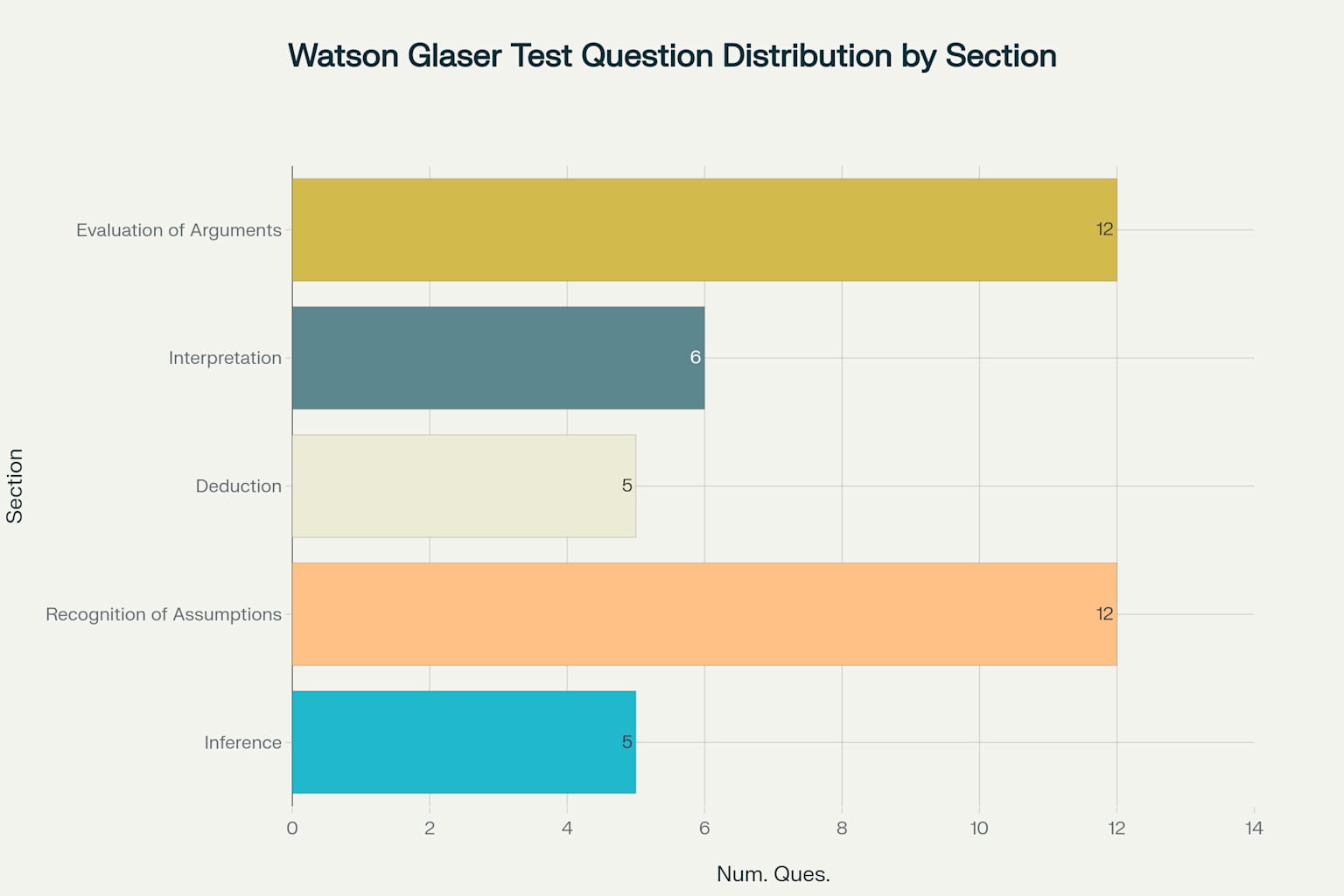
Distribution of 40 questions across the five sections of the Watson Glaser Critical Thinking Test.
What are the five Watson Glaser question types?
1. Inference questions (5 questions)
What They Test: Your ability to evaluate the likelihood of conclusions drawn from given information.Format: You receive a statement assumed to be true, followed by inferences that you must rate on a five-point scale:
- True - Definitely follows from the statement
- Probably True - More likely to be true than false
- Insufficient Data - Cannot be determined from the information
- Probably False - More likely to be false than true
- False - Definitely does not follow from the statement
Example Question:Statement: "The increase in virtual employees was 74% over the past five years, with 39% of this growth occurring in the last two years."Inference: "The increase in virtual employees was greater last year than it was four years ago."How to Answer: Since over half the growth (39% out of 74%) occurred in the last two years, it's reasonable to conclude the recent increase exceeded that of four years ago. Answer: Probably True.Key Strategy: Unlike other sections, inference questions allow the use of common knowledge alongside the given information. Focus on what can be reasonably concluded rather than what is explicitly stated.Need more than question examples? Explore our step-by-step Watson Glaser preparation guide for practical strategies and timelines.
2. Recognition of assumptions (12 questions)
What They Test: Your ability to identify unstated assumptions underlying statements.Format: You receive a statement followed by a proposed assumption, determining whether the assumption was made:
- Assumption Made - The statement takes this for granted
- Assumption Not Made - The statement doesn't require this assumption
Example Question:Statement: "It's only a matter of time until the development of supercomputers is completed."Assumption: "The development of supercomputers is possible."How to Answer: Use the Negative Test technique:
- Negate the assumption: "The development of supercomputers is impossible"
- Check if the original statement still makes sense
- If the statement becomes meaningless, the assumption was made
Since the statement would be meaningless if supercomputer development were impossible, Answer: Assumption Made.Key Strategy: Remember that assumptions don't need to be reasonable or factually correct — only whether they're necessary for the statement to make sense.
3. Deduction questions (5 questions)
What They Test: Your ability to determine whether conclusions follow absolutely and necessarily from given premises.Format: You receive premises followed by conclusions, determining logical necessity:
- Conclusion Follows - Must be true based on the premises
- Conclusion Does Not Follow - Not necessarily true from the premises
Example Question:Premise: "Trendy real estate assets are either located in non-central areas or are small."Conclusion: "Some trendy real estate assets are small."How to Answer: In Watson Glaser logic, "either A or B" means all items must be exclusively A or B. Since all trendy assets must be either non-central OR small, some must indeed be small. Answer: Conclusion Follows.Key Strategy: Focus on formal logic and ignore personal knowledge. Use techniques like the NOT Triangle (Negative, Transpose, Only) to rephrase complex premises.
4. Interpretation questions (6 questions)
What They Test: Your ability to determine whether conclusions follow beyond a reasonable doubt from given information.Format: Similar to deduction but with less rigid logical requirements:
- Conclusion Follows - Follows beyond reasonable doubt
- Conclusion Does Not Follow - Doesn't meet the reasonable doubt standard
Example Question:Passage: "My baby's difficulty is mostly physiological—her grandparents give her chocolates to eat and the sugar makes her hyperactive."Conclusion: "Sugar causes hyperactivity in the baby."How to Answer: The conclusion proposes a specific causal relationship not explicitly supported by the passage. This commits the "Reason Fallacy" — attributing causation without sufficient evidence. Answer: Conclusion Does Not Follow.Key Strategy: Watch for common fallacies including reason fallacy, indefinite pronoun errors, and unsupported generalizations.
5. Evaluation of arguments (12 questions)
What They Test: Your ability to assess whether arguments are strong or weak in relation to specific questions.Format: You receive a yes/no question followed by an argument supporting one position:
- Strong Argument - Both important and directly relevant
- Weak Argument - Either unimportant or not directly relevant
Example Question:Question: "Should companies provide free time for employees?"Argument: "No—employees are likely to use the free time to clean their homes, run errands, and meet with friends, and thus bring no benefit to the company whatsoever."How to Answer: The argument directly addresses the company's interests (relevance) and discusses significant potential costs (importance). The specific activities mentioned don't diminish the argument's validity. Answer: Strong Argument.Key Strategy: Evaluate arguments as if they were factually true, focusing solely on relevance and importance rather than personal agreement.
Test-taking strategies and common pitfalls
Time management techniques
With only 30 minutes for 40 questions, you have approximately 45 seconds per question. Successful test-takers recommend:
- Read questions carefully but avoid over-analyzing
- Move quickly through familiar question types to save time for challenging ones
- Don't second-guess initial answers unless you spot a clear error
- Practice under timed conditions to build speed and confidence
Common mistakes to avoid
SectionCommon MistakeSolutionInferenceUsing outside knowledge inappropriatelyRely on common knowledge, not specialized expertiseAssumptionsConfusing assumptions with conclusionsUse the Negative Test techniqueDeductionApplying real-world knowledgeFocus purely on logical necessityInterpretationAccepting reasonable but unsupported conclusionsDemand evidence beyond reasonable doubtEvaluationJudging arguments based on personal beliefsAssess only relevance and importance
Preparation strategies
Essential preparation steps include:
- Understand each section's unique rules – Don't apply the same approach across all sections
- Practice with authentic materials – Use official practice tests when available
- Develop systematic approaches – Create mental algorithms for each question type
- Time yourself consistently – Build speed gradually while maintaining accuracy
- Review your mistakes – Understand why wrong answers were incorrect
Scoring and performance benchmarks
The Watson Glaser uses percentile scoring based on comparison with other test-takers. Key benchmarks include:
- 80th percentile: 33–34 correct answers – competitive for top positions
- 90th percentile: 36–38 correct answers – excellent performance
- 95th–99th percentile: 39–40 correct answers – top-tier performance
Raw scores are converted to percentiles using sophisticated algorithms that account for question difficulty. The Watson Glaser III uses item response theory (IRT) to generate theta scores, making simple "number correct" comparisons misleading.Want to know whether free practice is enough for you? Compare your options in our free vs paid Watson Glaser test guide.
Why AssessFirst offers superior assessment solutions
While the Watson Glaser test focuses specifically on critical thinking through verbal reasoning, AssessFirst provides a more comprehensive approach to talent assessment. Our advanced psychometric solutions combine behavioral science and AI-powered analytics to evaluate personality, motivation, and cognitive abilities in a single, integrated profile.Unlike traditional tests that rely on a narrow set of questions, AssessFirst’s proprietary algorithms analyse over 800 behavioural and cognitive data points to deliver a deeper, more predictive understanding of each candidate’s potential. This holistic approach has been proven to increase employee performance by up to 15% and reduce staff turnover by up to 50% for our clients.If you’re ready to go beyond sample questions and boost your preparation, AssessFirst’s BRAIN cognitive test lets you benchmark your critical thinking skills, identify growth areas, and discover how modern AI-driven assessments can strengthen your performance on the Watson Glaser and beyond. Try it today and get actionable insights to level up your preparation.
Quick recap
- Understand the five Watson Glaser question types: inference, assumptions, deduction, interpretation, and argument evaluation.
- Use section-specific techniques like the Negative Test and NOT Triangle.
- Practise under timed conditions — aim for ~45 seconds per question.
- Focus only on given information and logical necessity — avoid assumptions.
- Benchmark your target score: aim for 33–34 correct answers for top firms.
- Combine realistic practice with modern tools like AssessFirst’s BRAIN test for deeper insights.
Ready to practise? Try our BRAIN test now!
Conclusion
Mastering Watson Glaser test questions requires understanding the unique demands of each section and developing systematic approaches to common question types. Success depends on recognizing the specific logical rules that govern each section, practicing under timed conditions, and avoiding common pitfalls that trap unprepared candidates.The test's difficulty stems not from requiring specialized knowledge, but from demanding precise analytical thinking under time pressure. By understanding the question formats, practicing with authentic examples, and developing reliable techniques for each section, you can significantly improve your performance and achieve the scores needed for competitive positions.Remember that preparation is key – while critical thinking abilities are partly innate, the specific skills tested by the Watson Glaser can be developed through focused practice and strategic preparation. Start early, practice consistently, and approach each section with the appropriate mindset and techniques.Key takeaway: Master the five question types, practise with real examples, aim for the 80th percentile and use modern tools likeAssessFirst’s BRAIN test to sharpen your score.Remember: success is learnable. With the right mindset and tools, you can crack the Watson Glaser with confidence.
FAQ
How long should I spend on each Watson Glaser question?With 40 questions in 30 minutes, you have approximately 45 seconds per question. However, some sections may require more time than others — plan to spend slightly more time on interpretation and evaluation questions, which tend to be more complex.Can I use outside knowledge when answering Watson Glaser questions?This depends on the section. Inference questions allow common knowledge, while deduction questions require purely logical reasoning. Assumption, interpretation, and evaluation questions should be answered based primarily on the given information.What's the difference between deduction and interpretation questions?Deduction questions require conclusions to follow absolutely and necessarily from the premises. Interpretation questions use the less strict standard of beyond a reasonable doubt. This makes interpretation questions actually more challenging despite the seemingly easier requirement.How is the Watson Glaser test scored?The test uses percentile scoring based on comparison with other test-takers. Raw scores are converted using sophisticated algorithms that account for question difficulty, particularly in the Watson Glaser III version.What score do I need to pass the Watson Glaser test?There's no universal "passing" score, as requirements vary by employer. However, 33–34 correct answers (80th percentile) is generally considered competitive for top positions. Some firms may accept lower scores, while others require 90th percentile or higher.How can I improve my Watson Glaser performance?Focus on understanding each section's unique rules, practicing under timed conditions, and developing systematic approaches to each question type. Regular practice with authentic materials and careful review of mistakes are essential for improvement.Check our full preparation guide for daily practice routines and proven methods.
Prêt à transformer votre processus de recrutement ?
Adieu les conjectures. Bonjour les décisions basées sur les compétences.