

Verbal Reasoning Test: complete guide with examples & tips 2025
Master verbal reasoning tests with our comprehensive guide. Learn question types, see examples, and discover proven strategies to excel.
Summarize this article with:

Verbal reasoning tests have become a cornerstone of modern recruitment, with over 80% of Fortune 500 companies using them to evaluate candidates. These assessments help employers identify individuals who can understand complex information, think critically, and communicate effectively – skills essential for success in today's workplace. However, many candidates approach these tests without proper preparation, leading to underperformance that doesn't reflect their true potential.In the UK, verbal reasoning tests are a standard part of graduate recruitment and professional hiring processes, used by employers like PwC, Deloitte and the Civil Service Fast Stream to shortlist top talent. Many companies now offer a free verbal reasoning practice test to help candidates get familiar with the format.Understanding how verbal reasoning tests work and developing effective strategies can significantly improve your performance. This comprehensive guide will walk you through everything you need to know about verbal reasoning tests, from their structure and question types to proven tips for success.In this article: You’ll learn what a verbal reasoning test UK is, the different types of tests (including graduate verbal reasoning test formats), how to practise with a free verbal reasoning practice test, plus step-by-step tips to succeed in online verbal reasoning test practice.
What is a verbal reasoning test?
A verbal reasoning test is a psychometric assessment designed to evaluate your ability to understand, analyze, and interpret written information. Unlike simple vocabulary or grammar tests, verbal reasoning assessments measure your capacity to:
- Comprehend complex written material under time pressure
- Draw logical conclusions from textual information
- Evaluate statements and assumptions objectively
- Identify relationships between concepts and ideas
These tests assess your cognitive ability to process language-based information rather than your knowledge of specific subjects. The content is typically unfamiliar to ensure you rely on reasoning skills rather than prior knowledge. This makes verbal reasoning tests particularly valuable for employers seeking to identify candidates with strong analytical thinking abilities.Verbal reasoning tests differ from other cognitive assessments by focusing specifically on language comprehension and logical reasoning with words. While numerical reasoning tests assess mathematical problem-solving, verbal reasoning tests evaluate your ability to work with written information, a skill crucial in virtually every professional role.
Types of verbal reasoning tests
Verbal reasoning tests come in various formats, each designed to assess different aspects of your language processing abilities. Understanding these different types will help you prepare more effectively:Question TypeDescriptionTime AllocationTrue/False/Cannot SayEvaluate statements based on a passage30–45 seconds per questionReading ComprehensionAnswer questions about written passages1–2 minutes per questionWord MeaningIdentify synonyms, antonyms, or word definitions20–30 seconds per questionSentence CompletionFill in missing words in sentences30–45 seconds per questionAnalogiesIdentify relationships between word pairs30–45 seconds per questionCritical ReasoningAnalyze arguments and draw logical conclusions1–2 minutes per questionTrue/False/Cannot Say questions are the most common format, particularly in tests by major providers like SHL and Kenexa. These present a passage followed by statements you must evaluate as true, false, or impossible to determine based solely on the given information.Reading Comprehension questions require you to extract specific information from passages and answer detailed questions about the content. These tests assess your ability to understand complex texts and identify key themes.Word Meaning questions evaluate your vocabulary and ability to understand words in context. They often involve synonyms, antonyms, or selecting the most appropriate word for a given sentence.Sentence Completion tests assess your understanding of sentence structure and context clues. You'll need to select the word or phrase that best completes a sentence logically.Analogies examine your ability to identify relationships between word pairs and apply similar logic to new pairs. These questions test both vocabulary and logical reasoning skills.Critical Reasoning questions present arguments or scenarios requiring you to identify assumptions, evaluate evidence, and draw logical conclusions.
How verbal reasoning tests work
Verbal reasoning tests follow a standardized format designed to assess your abilities under controlled conditions. Most tests are computer-based and completed online, either supervised or unsupervised.Test Structure: A typical verbal reasoning test consists of 20-40 questions to be completed in 15-30 minutes. Each question presents a passage of text (usually 100-400 words) followed by one or more statements or questions.Scoring System: Tests use raw scoring where each correct answer receives one point. Your raw score is then converted to a percentile score, showing how you performed relative to other test-takers. There's typically no penalty for incorrect answers, so educated guessing is beneficial when unsure.Adaptive Testing: Some modern tests use Item Response Theory (IRT), adjusting question difficulty based on your previous answers. This approach provides more accurate assessments with fewer questions.Test Environment: Whether online or in-person, you'll need a quiet environment with minimal distractions. Online tests often include practice questions at the beginning to familiarize you with the format.Time Management: With limited time per question, effective pacing is crucial. Most successful candidates spend 20-30 seconds reading each passage and 10-15 seconds per question. The key is finding the right balance between speed and accuracy.
Verbal reasoning test examples
True/False/Cannot say example
Passage: "The company's new sustainability initiative has led to a 25% reduction in energy consumption over the past year. This reduction has saved the company approximately $50,000 annually. The initiative includes installing solar panels, upgrading to LED lighting, and implementing energy-efficient equipment across all facilities."Statement: "The company will save $200,000 over four years through its sustainability initiative."Options: A) True B) False C) Cannot SayAnalysis: The passage states the company saves $50,000 annually. Simple mathematics ($50,000 × 4 = $200,000) might suggest the statement is true. However, the passage only provides data for one year and doesn't guarantee these savings will continue consistently for four years.Correct Answer: C) Cannot Say - We cannot determine future savings based on one year's data.
Reading comprehension example
Passage: "Remote work has transformed the modern workplace, with 42% of employees now working from home at least part-time. While this shift has increased flexibility and reduced commuting costs, it has also presented challenges in team collaboration and company culture maintenance. Organizations are investing in digital collaboration tools and virtual team-building activities to address these challenges."Question: "What is the main challenge of remote work mentioned in the passage?"Options: A) Reduced productivity B) Team collaboration difficulties C) Higher technology costs D) Employee isolationCorrect Answer: B) Team collaboration difficulties - This is explicitly mentioned as a challenge in the passage.
Word meaning example
Question: "Choose the word most similar in meaning to 'scrutinize':"Options: A) Approve B) Examine C) Ignore D) ModifyCorrect Answer: B) Examine - 'Scrutinize' means to examine or inspect closely and thoroughly.
Tips for success
Mastering verbal reasoning, especially a graduate verbal reasoning test, tests requires both strategic preparation and effective test-taking techniques. Here's how to maximize your performance:
Before the test
Practice Regularly: Consistent practice with various question types improves both speed and accuracy. Focus on timed practice to simulate real test conditions.Improve Reading Speed: Develop scanning techniques to quickly identify key information in passages. Practice reading business and academic texts to familiarize yourself with formal language structures.Build Vocabulary: Expand your vocabulary through regular reading of newspapers, journals, and professional publications. Focus on business terminology and formal language commonly used in test passages.Understand Test Formats: Familiarize yourself with different question types and their specific requirements. Know whether you're taking an SHL, Kenexa, or other provider's test, as each has slight variations.
During the test
Read Instructions Carefully: Take time to understand exactly what each question is asking. Don't rush through instructions as they may contain crucial information about the scoring system or answer format.Use Strategic Reading: Skim the passage first to get an overview, then read questions to know what information to look for. This approach is more efficient than reading the entire passage in detail initially.Stay Objective: Base answers only on information provided in the passage, not on your prior knowledge. If information isn't explicitly stated or can't be logically inferred, choose "Cannot Say" for true/false questions.Watch for Key Words: Pay attention to qualifiers like "all", "some", "never", "always" and "only" as they significantly impact meaning. These words often determine whether a statement is true or false.Manage Your Time: Don't spend too long on any single question. If you're unsure, make an educated guess and move on. You can return to difficult questions if time permits.
Common mistakes to avoid
Using External Knowledge: Don't let your expertise in a subject area influence your answers. The test assesses reasoning ability, not subject knowledge.Overthinking Questions: Your first instinct is often correct. Avoid changing answers unless you're confident you made an error.Ignoring Time Limits: Keep track of time and ensure you attempt all questions. Unanswered questions are automatically incorrect.
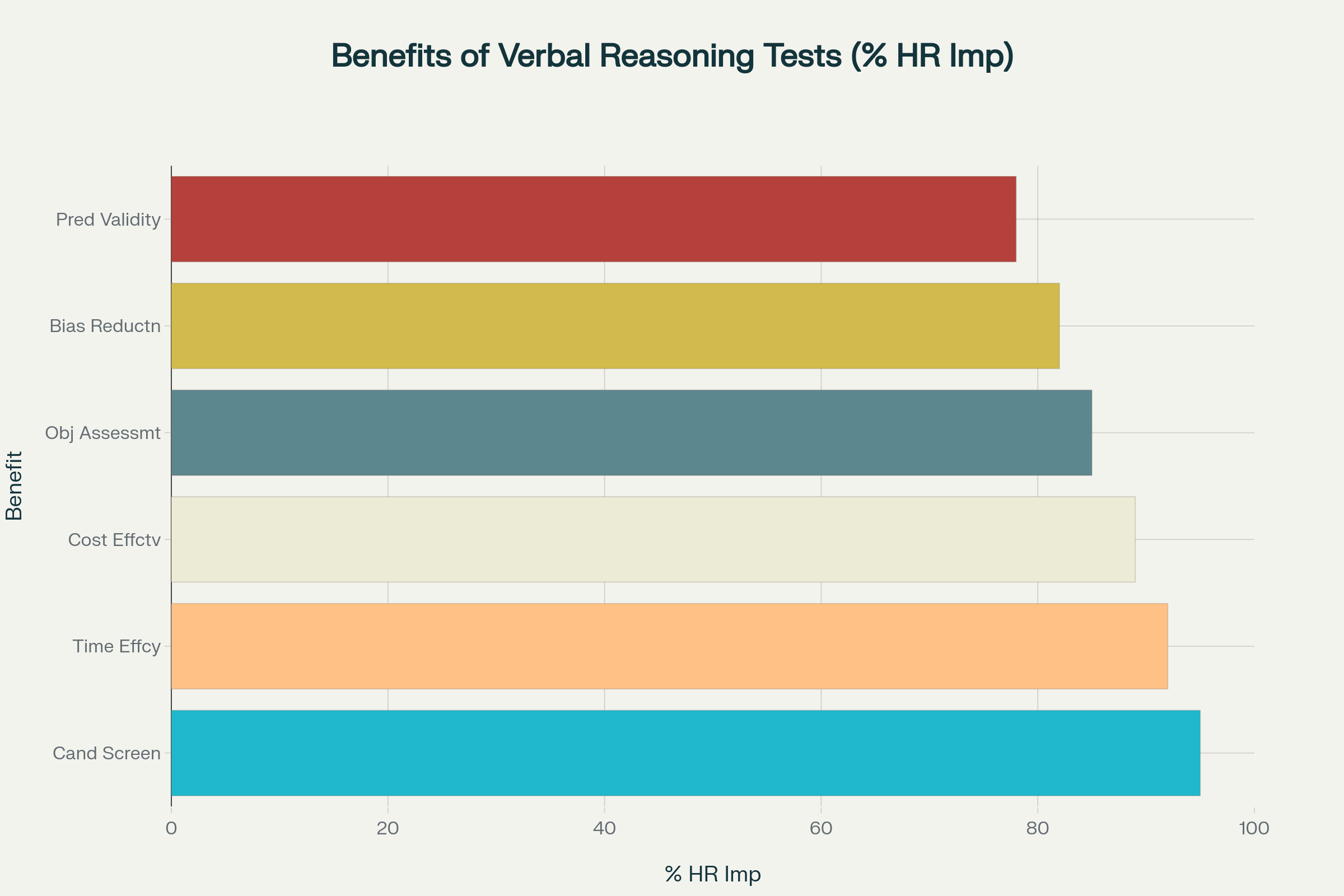
Benefits of Verbal Reasoning Tests for Employers - showing percentage of HR professionals rating each benefit as important
Why employers use verbal reasoning tests
Verbal reasoning tests have become essential tools in modern recruitment because they provide objective, predictive insights into candidate capabilities that traditional interviews cannot reliably assess. Top UK employers, including Barclays, Nomura and Standard Chartered, use verbal reasoning tests to identify the strongest applicants quickly and fairly.Predictive Validity: Research shows that candidates who perform well on verbal reasoning tests are 4 times more likely to succeed in their roles. These assessments effectively predict job performance across various industries and positions.Objective Assessment: Unlike subjective interview evaluations, verbal reasoning tests provide standardized, bias-free data about candidates' cognitive abilities. This objectivity helps organizations make fair hiring decisions based on merit rather than unconscious bias.Efficiency and Cost-Effectiveness: Verbal reasoning tests can quickly screen large numbers of candidates, allowing recruiters to focus time and resources on the most promising applicants. This efficiency significantly reduces hiring costs while improving quality of hire.Universal Application: These tests are valuable across industries because most roles require the ability to understand written information, analyze data, and communicate effectively. From customer service to executive positions, verbal reasoning skills are fundamental to workplace success.Risk Mitigation: By identifying candidates with strong communication and analytical skills early in the process, employers reduce the risk of costly hiring mistakes. Poor communication skills can lead to misunderstandings, errors, and reduced team effectiveness.Companies like Deutsche Bank, Nomura, and Standard Chartered use verbal reasoning tests because they provide reliable indicators of how candidates will perform in real-world situations requiring critical thinking and clear communication.
Conclusion
Verbal reasoning tests are powerful tools that assess your ability to understand, analyze, and work with written information – skills essential for success in today's workplace. By understanding the different question types, practicing regularly, and applying effective test-taking strategies, you can significantly improve your performance and demonstrate your true potential to employers.Remember that success in verbal reasoning tests comes from preparation, practice, and strategic thinking rather than innate ability. The key is to approach these assessments methodically, stay calm under pressure, and focus on the information provided rather than external knowledge.Whether you're preparing for your first verbal reasoning test or looking to improve your scores, consistent practice and the right strategies will help you succeed. Consider using professional assessment platforms like AssessFirst to get comprehensive insights into your cognitive abilities and identify areas for improvement.
FAQ
How long do verbal reasoning tests typically take?Most verbal reasoning tests take between 15–30 minutes to complete, with 20–40 questions. Each question should be answered in approximately 30–45 seconds.Can I practise a verbal reasoning test with AssessFirst?Yes! AssessFirst offers a free online verbal reasoning practice test UK candidates can use to prepare for real recruitment assessments. You’ll get instant feedback and insights into your strengths to help you perform better in graduate or professional verbal reasoning tests.Can I use a calculator during verbal reasoning tests?No, calculators are not permitted as verbal reasoning tests focus on language comprehension and logical reasoning, not mathematical calculations.What happens if I don't finish all questions?Unanswered questions are typically scored as incorrect, so it's better to guess than leave questions blank. Most tests don't penalize wrong answers.Are verbal reasoning tests culturally biased?While test providers work to minimize cultural bias, verbal reasoning tests may be more challenging for non-native speakers due to language complexity. However, they remain among the most fair and objective assessment methods available.How can I prepare if English isn't my first language?Focus on reading formal business and academic texts, practice with timed tests, and consider taking English proficiency courses if needed. Regular exposure to complex English texts will improve your comprehension speed.Do employers see my individual answers or just my overall score?Typically, employers only see your overall score and percentile ranking, not individual question responses. Some detailed reports may show performance by question type or topic area.Ready to boost your score?Discover UK/US verbal reasoning practice test with AssessFirst and get instant insights into your strengths.